Sunday, March 1, 2009

Cold Fermentation of Wheat

Since it is a cold winter here (including the upstairs closets), my latest batch of weissbier had the opportunity to ferment in a sub 60F environment. One word (awesome).

Ok, WLP380 will ferment under 60F, and the flavor is great. I am not a big fan of the banana, and, it did not give me any.

The crisp, spicy clove flavor that I long for in a weissbier is ever present, and that is the way it needs to be.

On another note, my extraction efficiency was really bad on that particular batch (around 60%), which made for a slightly thinner beer than I would have liked. It ended at 1.010 FG, whereas I am usually at 1.015FG or so. That is fine. At 4.2% alcohol or so, I can drink a bit more of it at any particular time.

Saturday, January 17, 2009

WB-06 vs WLP380 PT II

Ok, a couple of things went wrong with the last batch after stressing the WLP-380 yeast in the starter.

One is that it may have taken on an infection, although it is very difficult to recognize. I say this due to the fact I fermented the thing at around 68 - 70F, which will throw a lot of esters (smells) that I am not used to. My usual fermenting temp is below 64F. It just didn't smell like a 68-70F weissbier, and I am not talking about banana aroma either.

That all being said, the beer tastes fine, and the slightly strange smell goes away within 5 seconds of pouring the beer into the glass. The color is adequate as well.

WLP380 is still my yeast of choice, because given all that, it still made a fine weissbier.

Sunday, November 30, 2008

Start of Brewing Automation


A good bit of time has been spent on getting the homebrewery going in the basement. This is mostly due to the fact the lugging around large amounts of hot liquid is not so nice. Also, I can go all-electric and be able to control my temperatures a little better.

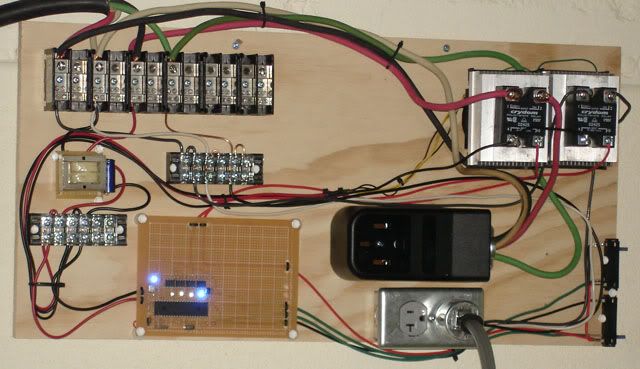
Along with bringing my brewing activities in the basement, I can now automate the system. As seen in the picture above, there is very little automation (due to switches on the side). But, soon enough my computer that is nearby should be able to control about 90% of the process. I will be able to control the SSR units via the computer (well, at least transmit what duty cycle I want, and then the microcontrollers will be able to do the dirty work). Also, I will get feedback into my computer on the temperature levels at the various stations, so it can know what duty cycle to pulse the SSRs at.

I still have to get the workbench to put the mashtun etc on, as well as the march pump with the ASCO solenoids (got them off of ebay). Eventually I will hookup copper pipes as well as a water filter, so I will just need to press a button and the water will fill up. One thing that I am still not so sure about is the water level sensor. Still, I need to figure out how to pull that off. I do not want to have to turn off the water flow manually... that's cheating. The continues...

Saturday, November 15, 2008

WB-06 vs WLP380

So, I have brewed two weissbier batches (same recipe) and have used these two different yeasts [ WB-06 and WLP380]. The WB-06 is the new dry German wheat yeast, and WLP380 is an older liquid strain.

Both wheat beers were fermented around 64 degrees, due to the fact I am not a huge fan of banana flavor, and am going more toward the clove side of things. Both beers also had a 105F rest in the mash schedule, with a 148F sac rest.

I prefer WLP380 over the WB-06. The dry yeast seems a little two tame, with not enough spicyness coming out. Luckily, no banana was thrown at the low fermentation temps either. I must say that for the price, it is not bad, and will do in a pinch if you do not have any liquid yeast lying around (or, are too cheap on that day to buy it).

Currently I am trying to stress the heck out of WLP380, and see how it does. I poured 1/4 tube of really old yeast into a 2 litre starter. It took 3 days to start fermenting. It smells alright, and it seems the starter was not taken over by any bacteriological forms. So, I will dump this starter into my weiss that I am brewing as I type.

Sunday, October 5, 2008

Amazing Weissbier Recipe

Here is a great weissbier recipe taken/adapted from this thread. It was meant to replicate a good Bavarian weissbier. In particular, Schneider-Weiss I believe. Anyhow, it turned out great, and is probably my best weissbier to date.


Weissbier-Selair 08_8_12

15-A Weizen/Weissbier

Date: 8/12/2008


BeerTools Pro Color Graphic


Size: 23.6 L
Efficiency: 66.0%
Attenuation: 76.9%
Calories: 172.0 kcal per 12.0 fl oz

Original Gravity: 1.052 (1.044 - 1.052)

=======================#========

Terminal Gravity: 1.012 (1.010 - 1.014)

===============#================

Color: 10.73 (2.0 - 8.0)

===============================#

Alcohol: 5.22% (4.3% - 5.6%)

===================#============

Bitterness: 12.7 (8.0 - 15.0)

==================#=============

Ingredients:


8.0 lb Pale Wheat Malt

5.0 lb Pilsner Malt

.9 lb Munich Malt

0.25 lb Caramunich® TYPE I

.05 lb Carafa Special® TYPE II

1.04 oz Hallertau Mittelfruh (3.2%) - added during boil, boiled 60 min

0.69 oz Hallertau Mittelfruh (3.2%) - added during boil, boiled 10 min

1 ea White Labs WLP380 Hefeweizen IV Ale


Schedule:


Ambient Air: 74 °F
Source Water: 74 °F
Elevation: 0.0 m

00:14:34 Mash In - Liquor: 10.37 L; Strike: 128.61 °F; Target: 115.0 °F
00:34:34 Rest - Rest: 20 min; Final: 113.9 °F
00:35:34 Infusion - Water: 10.34 L; Temperature: 195.4 °F; Target: 149 °F
01:35:34 Sac. Rest - Rest: 60 min; Final: 145.7 °F
02:05:34 Sparge - FirstRunnings: 2.21 L sparge @ 168 °F, 14.43 L collected, 15 min; Second: 14.26 L sparge @ 200 °F, 13.91 L collected, 15 min; Total Runoff: 28.99 L

Results generated by BeerTools Pro 1.5.0

Sunday, November 11, 2007

Robust Porter

The robust porter I outlined below has turned out pretty well. Very clean and flavorful. One of the better beers I have brewed. It seems that ever since I have been treating my water the beers have been getting better as well.

My basic water additions are 7g of calcium carbonate, 1.5 grams of Epsom Salt, and 1.5 grams of Baking Soda for about 8 to 10 gallons of water (inclusive of water that goes into the mash, of course). This is to replicate Munich water starting with a base of very mineral-less water (which seems to be my local water). The reason I want to replicate Munich water is due to the fact it tastes so good coming straight out of the tap. And, since beer is mostly water, this is a good starting point. In general this has worked for my darker beers, and even the weissbiers. I figured that the Munich brewers were using local untreated water for their weiss as well as their dunkels, so RA may not be as big a factor... Who knows.

A long time ago I had started using Campden tablets to rid the water of chlorine and chloramine. This has been working wonderfully. No need for water filters here...

Sunday, September 30, 2007

It's been a while, how poor of me

Anyhow, drool over this -> Two boils, one batch sparge. You can see where the chiller went in on the boiling sections by the dip in temperature. Below, I will post the recipe i made, it is a Jamil "Robust Porter", pitched US-05.


Photo Sharing and Video Hosting at Photobucket


RobustPorter 29_9_07


12-B Robust Porter


BeerTools Pro Color Graphic


Size: 5.44 gal

Efficiency: 60%

Attenuation: 80.5%

Calories: 197.16 kcal per 12.0 fl oz


Original Gravity: 1.060 (1.048 - 1.065)

==================#=============


Terminal Gravity: 1.012 (1.012 - 1.016)

======#=========================


Color: 29.01 (22.0 - 35.0)

================#===============


Alcohol: 6.31% (4.8% - 6.0%)

============================#===


Bitterness: 31.6 (25.0 - 50.0)

============#===================


Ingredients:


11.5 lb 2-Row Brewers Malt

1.5 lb Munich Malt

1.5 lb Crystal Malt 40°L

.5 lb Black Malt

.75 lb Chocolate Malt

2 oz East Kent Goldings - 4.5% (4.5%) - added during boil, boiled 60.0 min

.75 oz East Kent Goldings - 4.5% (4.5%) - added during boil, boiled 0.0 min


Schedule:


Ambient Air: 78.0 °F

Source Water: 78.0 °F

Elevation: 0.0 m


00:03:00 Mash In - Liquor: 4.33 gal; Strike: 170 °F; Target: 153 °F

01:03:00 Rest - Rest: 60.0 min; Final: 149.0 °F

01:04:00 Infusion - Water: 8.02 L; Temperature: 194.2 °F; Target: 162 °F

01:34:00 Sparge - FirstRunnings: 0.0 L sparge @ 168.0 °F, 4.07 gal collected, 15 min; Second: 4.1 gal sparge @ 170 °F, 4.1 gal collected, 15 min; Total Runoff: 8.35 gal


Notes:


Put some comments here:


Results generated by BeerTools Pro 1.1.0.6-alpha

Wednesday, May 23, 2007

Breaking in a New System

So of course, when I brewed my first batch, my efficiency was poor. Now, the first element I am going to blame this on is the crush. The grains were very coarse in comparison with my previous all-grain brews. My crushed grains are typically more powdery in texture... this time is was not. I know, I need to get a grain mill.

I broke in the system with a Weissbier. Here is the recipe, it is simple, sweet, and should work out just fine. I used WLP300 for the yeast. Good things have been said of WLP380, next time I will probably try it.


Weissbier 22_5_07


15-A Weizen/Weissbier


BeerTools Pro Color Graphic


Size: 16.36 L

Efficiency: 66.0%

Attenuation: 76.0%

Calories: 166.62 per 12.0 fl oz


Original Gravity: 1.050 (1.044 - 1.052)

====================#===========


Terminal Gravity: 1.012 (1.010 - 1.014)

================#===============


Color: 4.5 (2.0 - 8.0)

==============#=================


Alcohol: 5.0% (4.3% - 5.6%)

================#===============


Bitterness: 13.17 (8.0 - 15.0)

===================#============


Ingredients:


4.75 lbs Pale Wheat Malt

4.75 lbs Pilsner Malt

0.75 oz Hallertau Mittelfruh (3.2%) - added during boil, boiled 60 min

0.5 oz Hallertau Mittelfruh (3.2%) - added during boil, boiled 10 min

1.0 ea White Labs WLP300 Hefewizen Ale


Schedule:


Ambient Air: 70 °F

Source Water: 70.0 °F

Elevation: 0.0 m


00:10:10 Mash In - Liquor: 6.62 L; Strike: 137.7 °F; Target: 120 °F

00:30:10 Rest - Rest: 20 min; Final: 118.0 °F

00:31:10 Infusion - Water: 7.85 L; Temperature: 194.8 °F; Target: 154.0 °F

01:31:10 Sac. Rest - Rest: 60 min; Final: 148.7 °F

02:01:10 Sparge - FirstRunnings: 0.0 L sparge @ 168 °F, 7.19 L collected, 15 min; Second: 9.5 L sparge @ 200 °F, 9.5 L collected, 15 min; Total Runoff: 17.09 L


Notes:


Put some comments here:


Results generated by BeerTools Pro 1.0.26

Thursday, May 17, 2007

In Colorado

... is where I am at the moment. I have a chance now to taste a local "Colorado" beer. I saw in the latest Zymurgy (I think), that there is a brewery called Breckenridge. I wanted to try one of their IPAs or APAs, but the local liquor shop only had a Vanilla Porter, and one other one that I forgot the name of.

So, I decided to go with 5 Barrel Pale Ale from O'Dell Brewing in Fort Collins, CO. First, the aroma seemed a little stale, so I checked the date, and it is 061507, which means it is almost expired. I suppose. There is no noticeably distinct hop aroma or flavor in it, so I suspect a huge blend. Ok, so on the bottle it says that they run it through a hop-back, and that 4 hops are added in the boil. I would expect much bigger aroma, but again, the beer might be old. It tasted fine, fairly similar to SNPA. I am not a BJCP judge or anything (yet), so I will not go through the ratings for aroma, flavor, appearance, etc...

Sunday, May 13, 2007

The Ordinary Bitter

turned out pretty well. The FG was a little higher than I wanted (1.016). This was completely out of my control because the extract brand/make determines this, not myself. If I would have mashed this, it would have dropped below 1.010, as have most of my previous brews. This was due to low mashing temperatures, and the use of US-05 (previously US-56).

I ended up having to use a packet of US-05, because I did not make a starter on the WLP002. After almost 24 hours, there was little if any airlock activity, so I could not risk things, and pitched the cal ale yeast. I do not think this was a problem, because the yeast is fairly flavorless, and there is also a whole vial of "50/50 alive/dead" WLP002 to add some of the correct flavor in there.

The beer has turned out good. This has to have been my fastest turnaround ever as far as the "boil->bottle->drinking" time is concerned. The whole process was 2 weeks. Not bad in my opinion.

The only thing i wish that could have gone better is the MoreBeer Marris Otter extract finishing out a little drier. I know that US-05 can attenuate 80%, at least... so it is the extract that has the problem.

BTW, the beer tastes great, I carbonated it a 1.3 volumes CO2.

Wednesday, May 2, 2007

Short Lived

...was my brewing haitus... I wanted a low alcohol (session) beer, so I had to come back to brewing. Since I needed to do something easy (because of a lack of supplies), I made an extract batch of Ordinary Bitter. This is Jamil's recipe (converted from All-Grain), and I only made some small modifications to it to accomodate batch size. The original recipe is here. Otherwise, this is a tried and true recipe, and I look forward to drinking it. I hope it ferments quickly.

A note, the OG turned out a little higher than I had wanted... no problem though, I can handle the higher alcohol content. The beer is supposed to be under 3.8% or so. Also, this is scaled down to a 4.5 gallon batch... I could not do 5 gallons (not enough bottles, LOL)

Here it is.


Ordinary Bitter


8-A Standard/Ordinary Bitter


BeerTools Pro Color Graphic


Size: 4.49 gal

Efficiency: ----%

Attenuation: 76.8%

Calories: 138.74 per 12.0 fl oz


Original Gravity: 1.042 (1.032 - 1.040)

===========================#====


Terminal Gravity: 1.010 (1.007 - 1.011)

==================#=============


Color: 14.1 (4.0 - 14.0)

========================#=======


Alcohol: 4.21% (3.2% - 3.8%)

================================


Bitterness: 32.2 (25.0 - 35.0)

===================#============


Ingredients:


5 lbs Liquid Light (English Pale) MoreBeer

.5 lbs Crystal Malt 120°L

.25 lbs Special Roast Malt

0.8 oz East Kent Goldings (5.4%) - added during boil, boiled 60 min

0.5 oz East Kent Goldings (5.4%) - added during boil, boiled 30 min

0.5 oz East Kent Goldings (5.4%) - added during boil, boiled 1 min

1 ea White Labs WLP002 English Ale


Notes:


Put some comments here:


Results generated by BeerTools Pro 1.0.25


Thursday, April 26, 2007

Brewing Haitus

I have not brewed in over a month or so. The itch to do it again is being felt, but due to my current circumstances, I may have to wait a few more weeks. At least I am still drinking homebrew.

I shall return!